
Podcast Optimization for Coaches Made Simple in 7 Steps
I wrapped up a coaching session, not long ago, with an entrepreneur who has everything going for him.
He’s written a book. He’s got a proven coaching method. He’s created a podcast with 10 episodes already recorded. He’s clearly passionate, articulate, and has valuable content to share.
But something wasn’t clicking.
His podcast wasn’t converting listeners into coaching clients the way he hoped. He knew the content was good, but he couldn’t figure out what was missing.
Sound familiar?
As a podcast growth strategist and coach, I see this all the time with entrepreneurs and coaches. You have the expertise, the passion, and the content, but the technical and strategic pieces? Those are the blind spots that keep your podcast from actually growing your business.
In our 30-minute session, we identified seven simple tweaks that completely transformed his podcast positioning. And I’m sharing them with you because if you’re looking for podcast optimization for coaches that actually works, these insights might be exactly what you need right now.
The Podcast Optimization Problem Most Coaches Face
Here’s what I’ve noticed after working with dozens of entrepreneurs: you’re incredibly skilled at your craft. You can coach, teach, facilitate transformations, and create amazing content.
But when it comes to the strategic side of podcasting? The SEO, the optimization, the positioning that really converts listeners into clients?
That’s where things get murky.
Rafer Owens Jr. came to our session with everything in place, or so he thought. He had a welcome episode, social media links, and cover art. All the boxes were checked.
But here’s what I’ve learned from coaching hundreds of podcasters: it’s not about having these elements. It’s about having them work strategically to grow your business.
Let me break down the seven shifts I recommended in our session, and why they matter so much for coaches and entrepreneurs like you.
1. Ditch the Long Welcome Episode and Create a Trailer Instead
When I pulled up Rafer’s podcast, his first episode was 11 minutes long. Eleven minutes of introduction, explanation of the podcast concept, and what listeners could expect.
And look, it was good content! But here’s what I had to tell him: an 11-minute welcome episode is a massive commitment for someone who’s never heard of you before.
Think about your own behavior. When you’re scrolling through podcast apps looking for something new to listen to, are you going to invest 11 minutes in a stranger’s introduction? Probably not.
The solution? A trailer under three minutes.
Why this matters for your business: A trailer is the ultimate low-barrier entry point for potential clients to get to know you. It’s like a movie trailer, you’re giving them just enough to hook them, without overwhelming them. And in platforms like Buzzsprout, you can label it as a “trailer,” which gives it special algorithmic placement.
What I told Rafer to do: Go through that welcome episode and extract the most compelling pieces. What’s the core problem you solve? Who do you help? What transformation can listeners expect? Condense it into a punchy 2-3 minute trailer that makes people say, “I need to hear more from this person.”
Your action step: If you have a long welcome episode, repurpose it. Pull the best 2-3 minutes and create a dedicated trailer. Label it properly in your hosting platform. Make it your first impression that actually converts.
2. Podcast Call-to-Action Optimization: Make It Easy to Click
Here’s something I tell every client: people are lazy.
And I don’t mean that negatively, we’re all busy, distracted, and making hundreds of micro-decisions every day. If you make someone work to figure out how to connect with you, they simply won’t.
Rafer had a Linktree in his show notes. That’s a start! But I had to break it to him: that’s still too many clicks.
The better approach: Pull out your primary call to action and make it a direct, clickable link in your episode descriptions.
If Instagram is where you engage most with your audience, don’t hide it behind a Linktree. Put “Follow me on Instagram: [direct link]” right there in the description.
Want them to book a discovery call? Don’t make them hunt through a contact form dropdown menu. Put “Book a free discovery call: [direct link]” right in your episode notes.
Why this matters for your business: Every extra click is a conversion leak. Every additional step is a place where potential clients drop off. The easier you make it for people to take the next step with you, the more likely they are to actually do it.
What I told Rafer to do: Extract his most important links, Instagram, his coaching interest form, his speaking inquiry link, and put them directly in the episode descriptions. Then use the standard footer feature in Buzzsprout to automatically add these to every single episode.
Your action step: Audit your episode descriptions right now. How many clicks does it take for someone to work with you? Eliminate every unnecessary step between “interested listener” and “booked client.”
3. Podcast Cover Art Optimization for Maximum Impact
When I pulled up Rafer’s podcast in my player, I could immediately see the issue. His cover art had personality and color, but when it appeared as a tiny thumbnail alongside other podcasts? It got lost in the crowd.
I actually created a quick mockup to show him what I meant. When I showed him his current cover art in a lineup versus a simplified version, the difference was striking.
Here’s the hard truth I share with every client: your cover art isn’t about looking cool or creative. It’s about standing out and communicating clearly in a tiny thumbnail.
The changes I recommended were simple but powerful:
- Make the podcast title giant and bold
- Add a clear tagline in a contrasting color at the bottom
- Remove decorative elements (save those for social media graphics)
- Take the host name off (it already shows up in the podcast player)
Why this matters for your business: Your cover art is often the first impression potential clients have of your podcast. When they’re scrolling through dozens of options, yours needs to stop their thumb and make them think, “That’s exactly what I need.”
What I showed Rafer: I pulled up OnlyPod, where you can preview your cover art across all podcast players. Seeing it at actual size, not just the big beautiful version on your computer, is eye-opening.
Your action step: Look at your cover art at thumbnail size on your phone. Can you read the title clearly from a quick glance? Does it immediately communicate what your podcast is about and who it’s for? If not, it’s time to simplify.
4. Add a Tagline That Actually Tells People What You Do
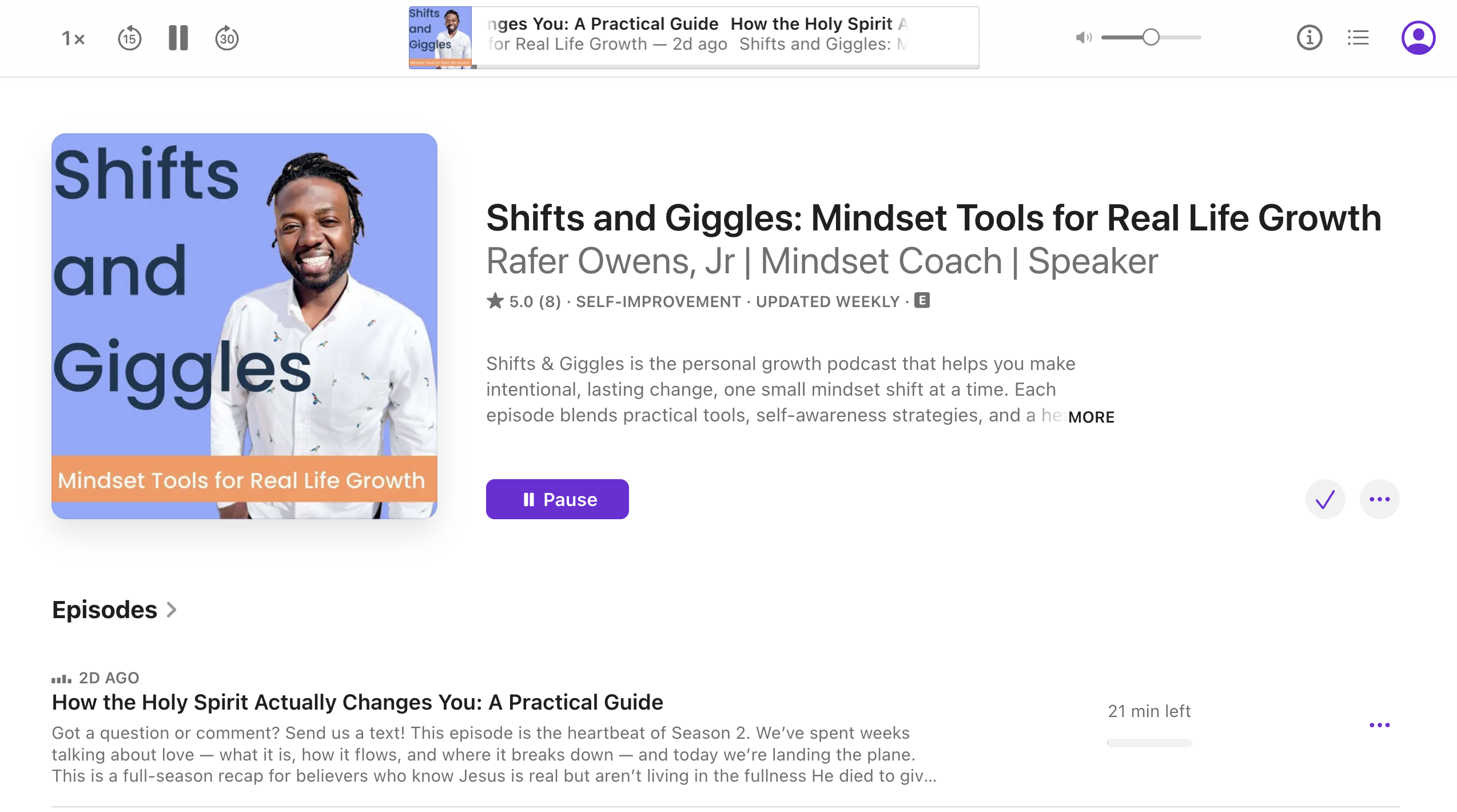
Rafer’s podcast is called “Shifts and Giggles.”
It’s clever! It’s memorable! And… it tells you absolutely nothing about what the podcast is actually about.
Is it comedy? Is it about moving? Career transitions? Personal development?
When I pointed this out, he immediately got it. A clever title is great for brand recall, but it does nothing for discoverability or clarity.
The solution? Add a tagline that does the heavy lifting.
Something like:
- “Mindset Shifts for Purpose-Driven Entrepreneurs”
- “Personal Growth Strategies for Christian Leaders”
- “Practical Coaching for Real-Life Transformation”
Suddenly, people don’t have to guess. They know immediately if this podcast is for them.
Why this matters for your business: Clarity converts. When someone can instantly identify that your podcast speaks to their specific situation, they’re far more likely to hit play and eventually reach out to work with you.
In the mockups I created for Rafer, I showed him how a clean title with a descriptive tagline in a contrasting color at the bottom made his podcast immediately understandable at a glance.
Your action step: If your podcast title is clever but vague, add a tagline that answers three questions: What problem do you solve? Who do you solve it for? What’s the transformation? Keep it under 10 words and make it bold on your cover art.

5. Master Podcast SEO Without the Overwhelm (Yes, Really)
When I asked Rafer about his familiarity with SEO, he gave me one of the most honest answers I’ve ever heard: “My brain has finally stopped spelling out the acronym every time I hear it. That’s where I am with SEO.”
I absolutely loved that response because it’s where so many coaches and entrepreneurs are. You know SEO is important, but it feels technical and overwhelming.
But here’s what I explained to him: SEO for podcasts isn’t about gaming algorithms. It’s simply about using the words your ideal clients are already searching for.
If you’re a Christian life coach, use words like “Christian,” “faith-based,” “Jesus,” and “spirituality” in your podcast description and episode titles.
If you work with busy moms, use “working moms,” “parenting,” and “work-life balance.”
It sounds almost too simple, but that’s the point. You’re not trying to trick anyone. You’re making it easy for the right people to find you when they’re actively looking for solutions.
Why this matters for your business: Organic discoverability is how you grow your podcast without spending thousands on ads. When potential clients search for solutions to their problems, you want your podcast to show up in their results.
What I told Rafer to do: Since he had just identified his ideal client (millennial Christians feeling stuck between Sunday and the rest of their life), we talked about incorporating keywords like “Christian,” “faith,” “personal growth,” and “spiritual development” naturally into his descriptions and titles.
Your action step: Make a list of 10-15 keywords your ideal client would actually type into a search bar. Then, naturally, incorporate 3-5 of these into each episode title and description. Don’t stuff them awkwardly…speak their language.
6. Find Your Niche (Even If It Scares You)
This is where our coaching session got really good.
Rafer had been trying to appeal to everyone because, as he put it, his coaching method genuinely can help everyone. It applies to relationships, parenting, careers, and personal growth across the board.
And he’s not wrong. But here’s what I see all the time: trying to appeal to everyone means you end up appealing to no one.
Then he dropped this bomb: “I am currently reading DotCom Secrets by Russell Brunson, and I just identified my dream customer last Friday.”
I literally said, “Oh my gosh, I love it.”
His ideal listener? The millennial Christian who’s been in church their whole life feels stuck and knows there’s a gap between what happens on Sunday and the rest of their life.
That’s incredibly specific. And when I saw his face, I could tell it scared him a little.
But you know what happened next? Everything else clicked into place. His messaging, his episode topics, his categories, his keywords, it all became crystal clear because he finally knew exactly who he was talking to.
Why this matters for your business: When you try to coach everyone, your marketing is vague, and your message gets diluted. When you get specific about who you serve, people either recognize themselves immediately and lean in hard, or they know it’s not for them and move on. Either way, you’re attracting the RIGHT people, the ones who will actually hire you.
What I told Rafer: You can absolutely shift your niche by season if you want. Season one can focus on millennial Christians. Season two could pivot to entrepreneurs or parents. Your method stays the same; you’re just applying it to different audiences. That flexibility actually makes podcasting perfect for coaches with versatile methods.
Your action step: Complete this sentence: “I help [specific type of person] who [specific problem/situation] to [specific transformation].” The more specific you can be, the better. And yes, it’s okay to feel scared when you narrow down—that fear usually means you’re onto something.
7. Make the Ask (Promote Your Services Without Being Salesy)
This is where I had to give Rafer a little tough love.
I told him to add a direct call to action in his episode descriptions: “If you want to work through this with me in coaching, click the link below.”
And he froze.
Then he said something that honestly broke my heart a little: “There’s a moment in these situations where I’m like, where’s the moment where I’m gonna freak out and be like, ‘but can I do that?’ And you just did it. You just did the part that I’m now afraid to do.”
Can I be honest with you? I hear this from SO many coaches and entrepreneurs.
You’ll happily create free content all day long. You’ll pour hours into your podcast, genuinely helping people and sharing your expertise. But asking someone to actually work with you? That feels… salesy. Pushy. Uncomfortable.
But here’s the reframe I gave him (and I’m giving you): if your coaching has genuinely transformed people’s lives, keeping it a secret isn’t humble…it’s a disservice.
You’re not being pushy by letting people know how to work with you. You’re making it easy for the people who desperately need your help to actually get it.
Why this matters for your business: Your podcast is a powerful tool for demonstrating your expertise and building trust. But if you never tell people how to work with you, you’re leaving both money AND transformations on the table.
Those listeners who are ready to go deeper? They’re waiting for you to invite them. Don’t make them hunt for the answer.
What I told Rafer to do: Pull his coaching inquiry form out of the dropdown menu and give it a direct link in every episode description. Add language like “Ready to work through this together? Book a discovery call here: [link].” Simple, clear, and not salesy at all.
Your action step: Add a clear, conversational CTA to your episode descriptions. It can be as simple as: “Want to dive deeper into this? Let’s talk: [link]” or “Ready to work on this together? Check out my coaching here: [link].” That’s it. No need to be pushy, just clear and available.
The Real Transformation Isn’t in the Tactics
Here’s what I’ve learned from coaching podcasters: the missing piece is almost never some secret strategy or hidden tactic.
It’s clarity.
Clarity about who you serve. Clarity about what you’re offering. Clarity about why it matters and how people can work with you.
All these tactical tweaks, the trailer, the cover art, the SEO, the CTAs, they’re not just technical checkbox items. They’re the foundation of effective podcast optimization for coaches. They’re tools for communicating your value clearly and attracting the right people to your business.
By the end of our session, Rafer said something that made my day: “This is huge. My wife is about to not hear the end of this.”
That’s exactly what I want for you, too.
You don’t need to completely overhaul everything. You probably need a few strategic tweaks that bring clarity to your message and make it ridiculously easy for the right people to find and work with you.
What to Do Next
If you’re a coach or entrepreneur with a podcast that’s not converting the way you’d hoped, here’s what I recommend for podcast optimization for coaches:
Audit your podcast against these seven elements:
- Do you have a short trailer (under 3 minutes)?
- Are your CTAs direct and clickable, or hidden behind multiple steps?
- Does your cover art communicate clearly at thumbnail size?
- If your title is clever, do you have a descriptive tagline?
- Are you using keywords your ideal clients actually search for?
- Have you identified your specific niche, or are you trying to appeal to everyone?
- Are you making clear invitations for people to work with you?
Be honest with yourself about where the gaps are. Usually, you only need to clarify and simplify what’s already there and not redo everything.
If you’re feeling stuck or want expert eyes on your podcast, that’s exactly what I do. I help coaches and entrepreneurs turn their podcasts into client-generating machines through strategic audits and optimization.
Sometimes you need someone to look at your show with fresh eyes and point out the blind spots you can’t see yourself. That’s what happened with Rafer, and I’d love to do the same for you.
Frequently Asked Questions About Podcast Optimization for Coaches
How do you optimize a podcast for business?
Optimizing a podcast for business starts with clarity and strategic positioning. Create a short trailer under three minutes to lower the barrier to entry for new listeners. Simplify your calls to action by adding direct, clickable links in your episode descriptions rather than hiding them behind multiple steps. Use clear cover art with descriptive taglines so people immediately understand what your podcast offers. Incorporate SEO keywords that your ideal clients are actually searching for, niche down to a specific audience, and make direct invitations for listeners to work with you in every episode description.
What makes a good podcast for coaches?
A good coaching podcast clearly identifies its niche audience and speaks directly to their specific pain points. It provides valuable, transformation-focused content that demonstrates your expertise while building trust with potential clients. The technical elements matter too: optimized cover art that stands out in podcast players, clear episode descriptions with relevant keywords, and direct pathways for listeners to become clients. Most importantly, it balances generous free content with clear invitations to go deeper through your coaching services.
How long should a podcast trailer be?
A podcast trailer should be under three minutes, ideally between 2 and 3. This provides a low-commitment introduction to your show that hooks potential listeners without overwhelming them. Think of it like a movie trailer: you’re giving them just enough to understand what you offer, who it’s for, and what transformation they can expect, while leaving them wanting more. A trailer is much more effective than an 11-minute welcome episode because it respects your audience’s time and makes it easy for them to decide if your podcast is right for them.
How often should I update my podcast SEO?
Your core podcast SEO elements, like your show description, category selection, and cover art, should be reviewed every 3-6 months or whenever you pivot your focus or niche. However, you should optimize each individual episode’s title and description as you publish it, incorporating relevant keywords naturally. If you identify a new niche or ideal client (like when you’re shifting between seasons), that’s the perfect time to update your keywords, tagline, and possibly your cover art to reflect your current positioning.
Should I niche down my podcast or keep it broad?
Niche down. While your coaching method might help everyone, trying to appeal to everyone means your message gets diluted, and you actually appeal to no one. When you get specific about who you serve, the right people recognize themselves immediately and lean in hard. Don’t worry, you can shift your niche by season if you want to serve different audiences with your method. Season one might focus on millennial Christians, season two on entrepreneurs, season three on parents. Your method stays the same; you’re just applying it to different audiences. That specificity in each season will serve you far better than trying to be everything to everyone all at once.
Let’s Work Together
I specialize in helping coaches and entrepreneurs optimize their podcasts so they actually grow their businesses. If you’re ready to turn your podcast into a client-generating asset, I’d love to start with a Get Found Audit where I identify what is stopping your podcast from being discovered.
In the meantime, I’d love to hear from you. What’s the biggest challenge you’re facing with your podcast right now? Connect with me on Threads.
Remember: sometimes the transformation you need isn’t a complete overhaul. Sometimes it’s just a few simple shifts that change everything.

Leah Bryant is a podcast growth strategist and coach who helps entrepreneurs and coaches turn their shows into powerful business assets. Connect with her at support@leahbryantco.com or listen to Podcasting Problem Solver for more podcast growth strategies.

Meet Leah
I help entrepreneurs build podcasts that grow their business with strategy, support, and less overwhelm.
I'm looking for...