How to Optimize Podcast Episodes for Search Engines (and Actually See Growth)
If you’ve been wondering how to optimize podcast episodes so they actually get found, you’re in the right place.
If your podcast is live, consistent, and still feels invisible…it’s not your content that’s the problem.
It’s your optimization.
Most established business owners I work with are doing the hard part, showing up, recording, and publishing week after week. But they’re completely skipping the layer that turns episodes into discoverable, compounding assets. And that’s why downloads stall out, rankings stay meh, and leads feel like they’re playing hide-and-seek.
Let me show you how I actually optimize podcast episodes for real search growth…the kind that increases downloads, boosts Apple rankings, and brings in qualified leads from Google.
Not the “post consistently and hope for the best” advice. The strategic kind.
First, Let’s Get Clear on What “Podcast SEO” Really Means
For my clients, optimization isn’t about chasing vanity metrics or playing algorithm roulette. It’s about improving:
- Downloads: Consistent, organic growth month over month (not just launch spikes)
- Apple Podcasts rankings: Moving up in category charts, so you’re discoverable to new listeners
- Consumption rates: People really listening and for how long, not just downloading and ghosting
- Inbound lead inquiries: Listeners becoming clients or customers
- Google search visibility: Your episodes showing up when people search for solutions you provide
If your SEO isn’t feeding at least one of those? It’s busy work disguised as strategy.
The 3 Most Common SEO Mistakes I See (Even in Big Shows)
These three things alone quietly cap growth, and I see them everywhere:
- No keywords in the podcast title. A clever name is not a search strategy. I don’t care how witty it is.
- A vague, unstrategic show description. This is one of the most heavily weighted SEO fields in the podcast universe, and most people waste it on writing their biography or bland introductions.
- Ignoring the author field entirely. This is prime real estate for keyword association, and almost everyone leaves it blank or just slaps their business name in there.
If this stings a little… good. That means there’s easy upside waiting for you.
What a Good Episode Description Actually Looks Like (vs. What Most People Write)
Let me show you the difference, because this is where I see the most wasted opportunity.
Most people write their episode description once, hit publish, and never look at it again. Meanwhile, it’s sitting there doing absolutely nothing for discoverability and costing them downloads every single day.
Bad Description (Generic, No SEO, No Hook):
“In this episode, we talk about growing your business and some tips I’ve learned along the way. It’s a great conversation, and I hope you enjoy it!”
What’s wrong with this:
- Zero keywords
- No clear benefit
- Sounds like every other podcast ever
- Doesn’t tell search engines OR humans what this episode is about
Good Description (Strategic, Searchable, Compelling):
“Struggling to turn podcast downloads into actual clients? In this episode, I break down the 3 biggest mistakes business owners make with their podcast lead-generation strategy and the simple framework I use to turn listeners into buyers. If you’ve been wondering why your show isn’t generating leads, this episode will show you exactly what’s missing.”
Why this works:
- Primary keyword in first sentence: “podcast downloads,” “clients,” “lead generation”
- Clear benefit: you’re going to learn 3 mistakes + a framework
- Speaks to search intent: people Googling “why isn’t my podcast generating leads” will find this
- Sounds like a human wrote it, not a robot
Your description needs to do three jobs:
- Tell search engines what this episode is about (keywords)
- Tell humans why they should listen (benefit)
- Sound like you, not a corporate press release (voice)
If it’s missing any of those, you’re leaving growth on the table.
And listen, this doesn’t just apply to episode descriptions. Your main podcast description needs the same treatment.
Most people write a bland bio: “Hi, I’m [name] and I help people with [thing].”
Instead, your show description should include 6-8 of the most-searched questions your audience is asking, position you as the person who answers them, and make it immediately clear what they’ll learn by listening.
Treat it like your podcast’s storefront. Because that’s exactly what it is.
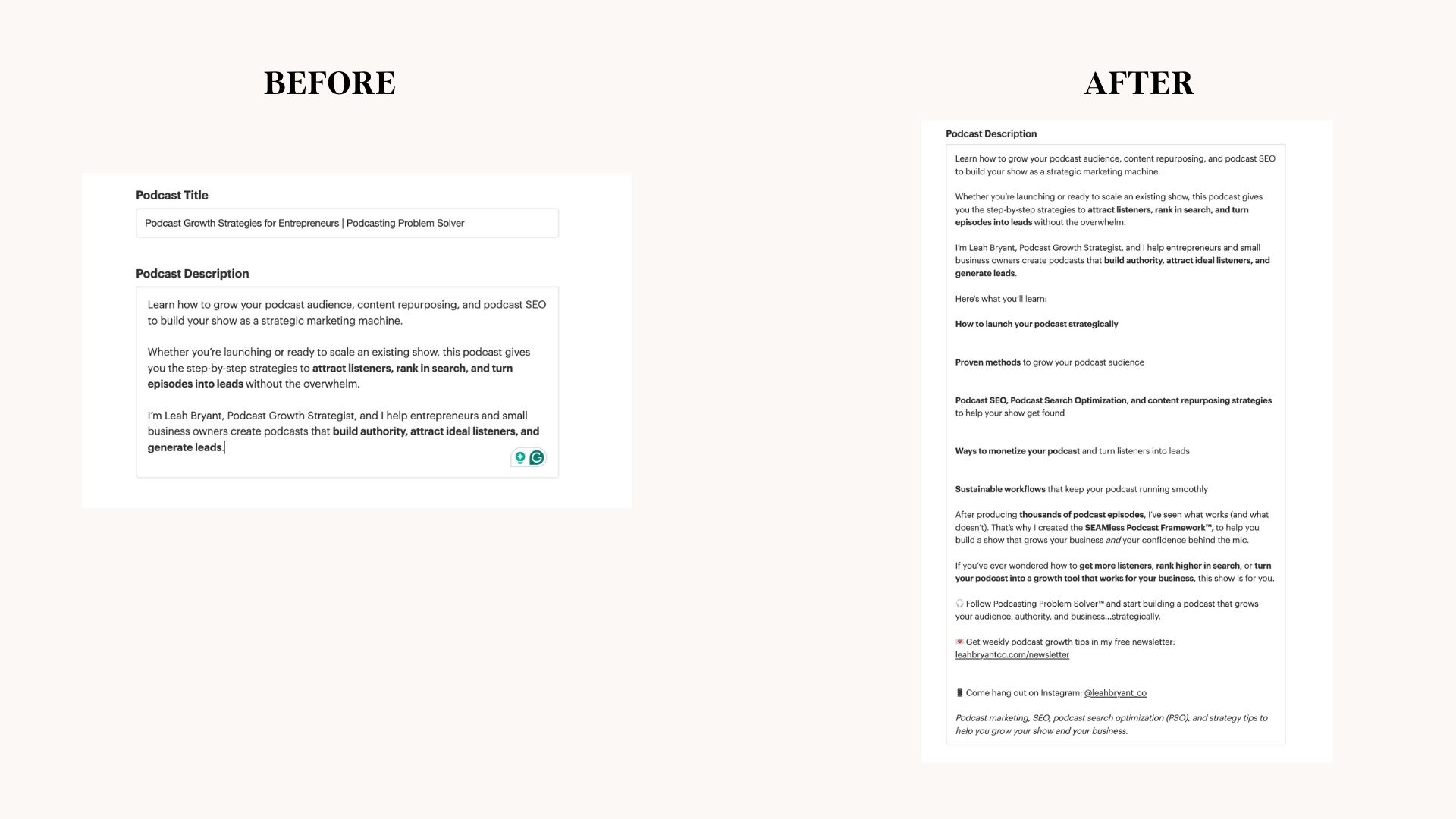
My Actual Post-Publish SEO Workflow
Let me share something with you… I do most of the heavy lifting before the episode goes live.
But after it publishes? I’m optimizing across:
- Apple Podcasts
- Spotify
- YouTube Music
- Blog/website
Then I check metrics at day 7, day 30, and day 90, and update as needed.
Every episode gets treated like a searchable asset, not just an audio file. Because once it’s published, that episode should be working for you by bringing in listeners, leads, and long-tail traffic for months (or years).
My Platform-Specific Optimization Checklist (The Actual Steps)
This is where both your show-level details AND episode details are set—and they distribute to all players from here.
Show-Level Optimization (set once, impacts everything):
- Podcast title: Your show name should include keywords your audience searches for. Not just a clever name—a searchable one.
- Podcast description: This is your show’s homepage across all platforms. Include 6-8 high-search questions your audience is asking, who you are, and what listeners will get. (See the example above for how to structure this.)
- Author name field: Most people leave this blank or just put their business name. Use keywords here, it’s prime real estate for search association.
- Category placement: Double-check you’re in the right categories for your niche. This affects discoverability and ranking potential.
- Keywords/tags: If your host allows them, add 5-10 keywords that describe your show’s main topics. Think about what your ideal listener would actually search for.
Episode-Level Optimization (every single episode):
- Episode title: Keywords front-loaded, clear benefit, under 60 characters. This pushes to Apple, Spotify, YouTube Music, and everywhere else.
- Episode description: First 2-3 sentences need to hook AND include your primary keyword. These show in search previews across platforms.
- Keywords/tags: Add 3-5 specific keywords for each episode topic. Be strategic, as these help platforms categorize and surface your content.
Spotify
- Playlists: I manually add strategic episodes to relevant public playlists when possible
YouTube Music
- Video file optimization: If you’re publishing a video, the filename matters (use keywords, not “Episode_47_final_FINAL_v2.mp4”)
- Captions/subtitles: These are indexed by search engines. Use them.
Google (Blog/Website)
- Blog post structure: H2s with keywords, at least 800 words, internal links to other episodes
- Show notes: Structured with headers, bullets, timestamps. Apple links to them, so readability matters for both platforms.
- Meta description: This shows up in Google search results—make it compelling with your primary keyword
- Image alt text: Every single image gets descriptive alt text with relevant keywords
- URL structure: Clean, keyword-rich slugs (example.com/how-to-grow-podcast-downloads, not example.com/ep-47)
This isn’t “post and pray.” This is strategic asset creation.
Real Client Case Study: 56% Download Growth in 14 Days
Jennifer came to me with zero SEO strategy. No keyword structure. Just a solid show that nobody could find.
Here’s what we changed:
- Updated her podcast title with a keyword-rich tagline
- Optimized her author field with strategic keywords
- Rewrote her description with search intent in mind
- Refined a few episode titles for discoverability
That’s it. No rebrand. No content overhaul.
Result: 56% increase in downloads in 14 days.
SEO doesn’t need years to work. It needs a strategy.
The changes Jennifer made weren’t complicated. They were just intentional. And that’s exactly what I’m about to show you, the specific process I use to find those high-impact optimizations.
Jennifer isn’t the only one who’s seen this kind of growth. Read more client results here and here.
How I Approach Keyword Research (Without Sounding Like a Robot)
I use Keysearch, Google Search, and good old-fashioned competitor reverse-engineering.
But remember, tools alone don’t drive results. We have to also add interpretation to the mix.
Here’s what I’m really looking for:
1. The Language Gap
People search: “how to get podcast listeners”
They do NOT search: “audience acquisition strategies”
If your content speaks fluent industry jargon but your audience speaks real life, you’ll miss them in search every single time.
2. The Intent Behind the Search
Are they looking for a quick fix? Or a full strategy?
That changes how I structure the episode, the title, and the blog content.
3. The “Why Is This Ranking?” Signal
If mediocre content is ranking #3, that’s not competition, friend, that’s opportunity. That tells me the keyword is underserved and ripe for the taking.
4. The Human Translation
I don’t insert keywords like I’m playing SEO Mad Libs.
I weave them so they sound natural, persuasive, and real. Like an actual human wrote them.
My pattern recognition (thank you, fraud investigation training) spots the gap where search behavior meets real frustration. That’s where growth lives.
The Two Most Overlooked SEO Assets
If I had to pick where most growth actually comes from, it’s these two:
- Podcast descriptions
- Blog posts with internal links
These are your compounding engines. Social content expires in 24 hours. Properly linked blog traffic doesn’t.
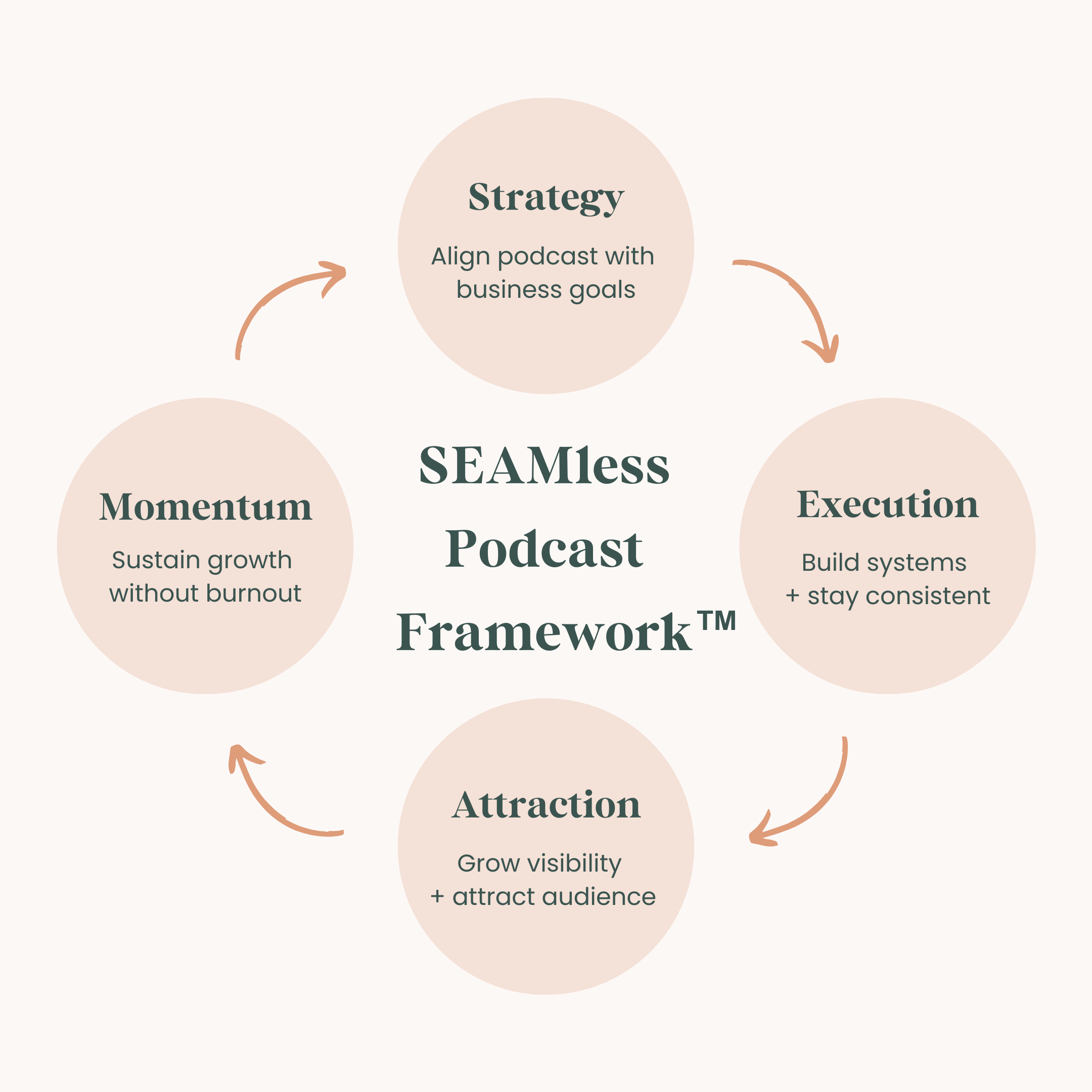
How the SEAMless Framework™ Powers Podcast SEO
This is how optimization fits inside my full strategy:
Strategy: Topics are chosen based on what people actually search for, not moods, trends, or what you feel like talking about.
Execution: Formatting (titles, descriptions, show notes) makes episodes readable for search engines and humans.
Attraction: Keywords, metadata, and platforms work together to make your show findable.
Momentum: Evergreen optimization creates long-term traffic that stacks over time.
SEO isn’t a tactic you bolt on at the end. It’s a system.
Want to learn more about how the SEAMless Framework works? Read the full breakdown here.
The Truth About Repurposing (That Most People Don’t Want to Hear)
Most podcasters repurpose to feel busy.
They turn one episode into 47 pieces of content, post it everywhere, check all the boxes, and then wonder why nothing actually moves.
Here’s what actually works:
- One search-optimized blog post with internal links → long-term discoverability
- Pinterest repurposing with SEO structure → searchable traffic
- Email nurture tied to strategic episodes → lead generation
Here’s what feels productive but rarely converts:
- 12 Instagram graphics that disappear in 24 hours
- Carousels that get 47 likes but zero inquiries
- Content made for visibility instead of search or conversion
Strategic repurposing builds assets, and busy-work repurposing builds burnout.
How to Actually Track if Your Podcast SEO Is Working (Without Obsessing Over Vanity Metrics)
Here’s what I’m looking at on day 7, day 30, and day 90, and what actually matters.
Tracking podcast SEO isn’t about staring at dashboards all day or being an SEO expert. It’s about knowing which metrics signal real growth versus noise.
I use a 7-30-90-day framework because it captures early momentum, confirms traction, and identifies compound growth. Here’s what I’m actually watching at each checkpoint, and what you can ignore.
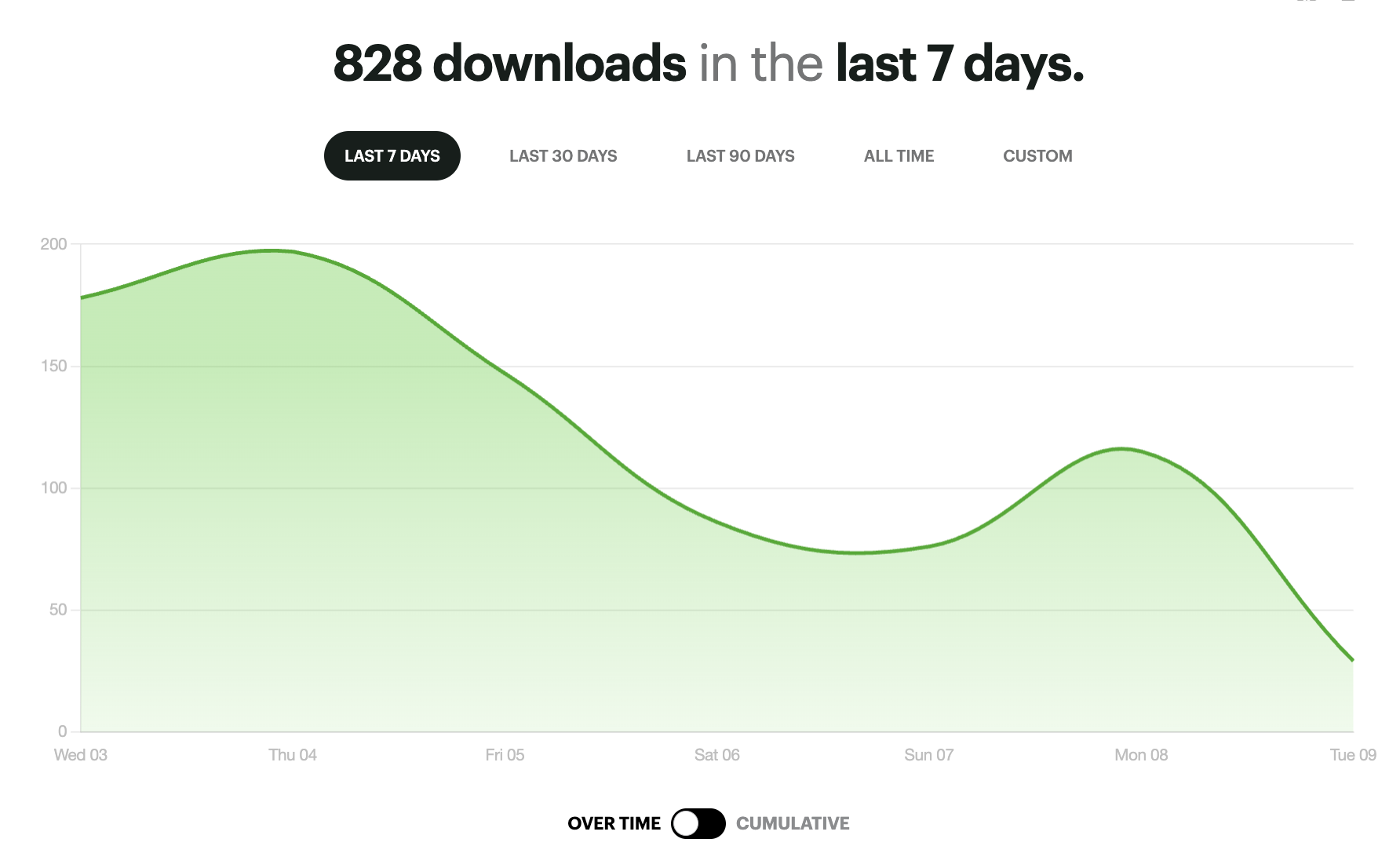
Day 7: The Early Signal Check
What I’m watching:
- Download rate – Are downloads coming in faster than previous episodes at this same point?
- Apple ranking movement – Did the episode crack the top 100 in any categories?
- Search impressions (if you have Google Search Console connected to your blog) – Is it showing up in search at all yet?
What I’m NOT watching:
- Social media likes, shares, comments (nice to have, but not indicators of SEO performance)
Red flags at day 7: If downloads are significantly lower than your average at this point, the title or description might not be compelling enough. Time to test a tweak.
Day 30: The Momentum Check
What I’m watching:
- Total downloads vs. previous episodes at the 30-day mark
- Google Search Console data – What keywords is this episode actually ranking for? Are they the ones you targeted?
- Apple category rankings – Has it climbed or dropped?
- Referral traffic – Where are listeners finding this episode? (Blog? Search? Social?)
What I’m looking for: Long-tail keyword traction. If you’re starting to rank for variations of your target keyword, that’s momentum building.
Decision point: If an episode is underperforming at 30 days, I’ll update the title, description, or blog post structure. Sometimes a small tweak unlocks growth.
Day 90: The Compound Effect
What I’m watching:
- Steady-state downloads – Is this episode still getting discovered organically, or did it flatline after week 2?
- Backlink activity – Has anyone linked to this episode or blog post?
- Keyword ranking stability – Are you holding (or climbing) in search results?
What actually matters here: Evergreen episodes should still be getting downloads at day 90. If they’re not, your SEO strategy needs work.
Pattern recognition (my investigator brain at work): I’m looking for which episodes have “legs”, the ones that keep compounding over time. Those tell me what topics, formats, and keyword strategies are working best. Then I reverse-engineer that success into future episodes.
The One Metric That Matters Most
At the end of the day, I care about qualified lead inquiries.
Downloads are great. Rankings are great. But if your podcast isn’t turning listeners into leads, the SEO isn’t doing its job.
Track how many people mention your podcast when they inquire, book a call, or become a client. That’s the metric that pays your mortgage.
Who This Strategy Is For (and Who It’s Not)
This approach is built for:
- Established business owners
- Brands using podcasts for authority and lead generation
- People willing to invest in their platform strategically
This is NOT for:
- Total beginners who are still figuring out their mic setup
- Hobby podcasters
- Anyone who doesn’t have the time or desire to optimize long-term
If Your Podcast Isn’t Growing, It’s a Discoverability Problem
If your podcast isn’t bringing in consistent downloads, rankings, or leads, it’s rarely a content problem.
It’s a discoverability problem.
And the fastest way to fix that is through:
- Strategic keyword placement – Not just stuffing keywords, but weaving them into titles, descriptions, and content in ways that sound human and match what people actually search for
- Intent-driven content – Creating episodes based on what your audience is actively looking for, not just what you feel like talking about
- Platform-specific optimization – Understanding that Apple, Spotify, YouTube, and Google all reward different things, and optimizing accordingly
- Repurposing that actually compounds – Turning episodes into search-optimized blog posts and assets that work for you long-term, not just content that expires in 24 hours
Your content deserves to be found. Let’s make sure it is.

Want Me to Look Your Podcast SEO?
If you just read this and thought, “Oh my heavens to Betsy, I’ve been doing this all wrong,” you’re in the right place.
Most of the podcasters I work with are smart, consistent, and creating great content. They’re just missing the strategic layer that makes it discoverable.
Here’s what I’ll do in a Get Found Audit:
- Analyze your current SEO setup (title, description, author field, episode structure)
- Identify the specific blockers keeping your show from growing
- Show you exactly what to fix first for the fastest impact
- Give you a custom Notion roadmap based on what your audience is actually searching for
No generic advice. Just pattern recognition from someone who’s optimized over 2,000 episodes and launched 40+ podcasts.

Meet Leah
I help entrepreneurs build podcasts that grow their business with strategy, support, and less overwhelm.
I'm looking for...