
Podcast Hooks: How To Keep Listeners Engaged Past the Intro
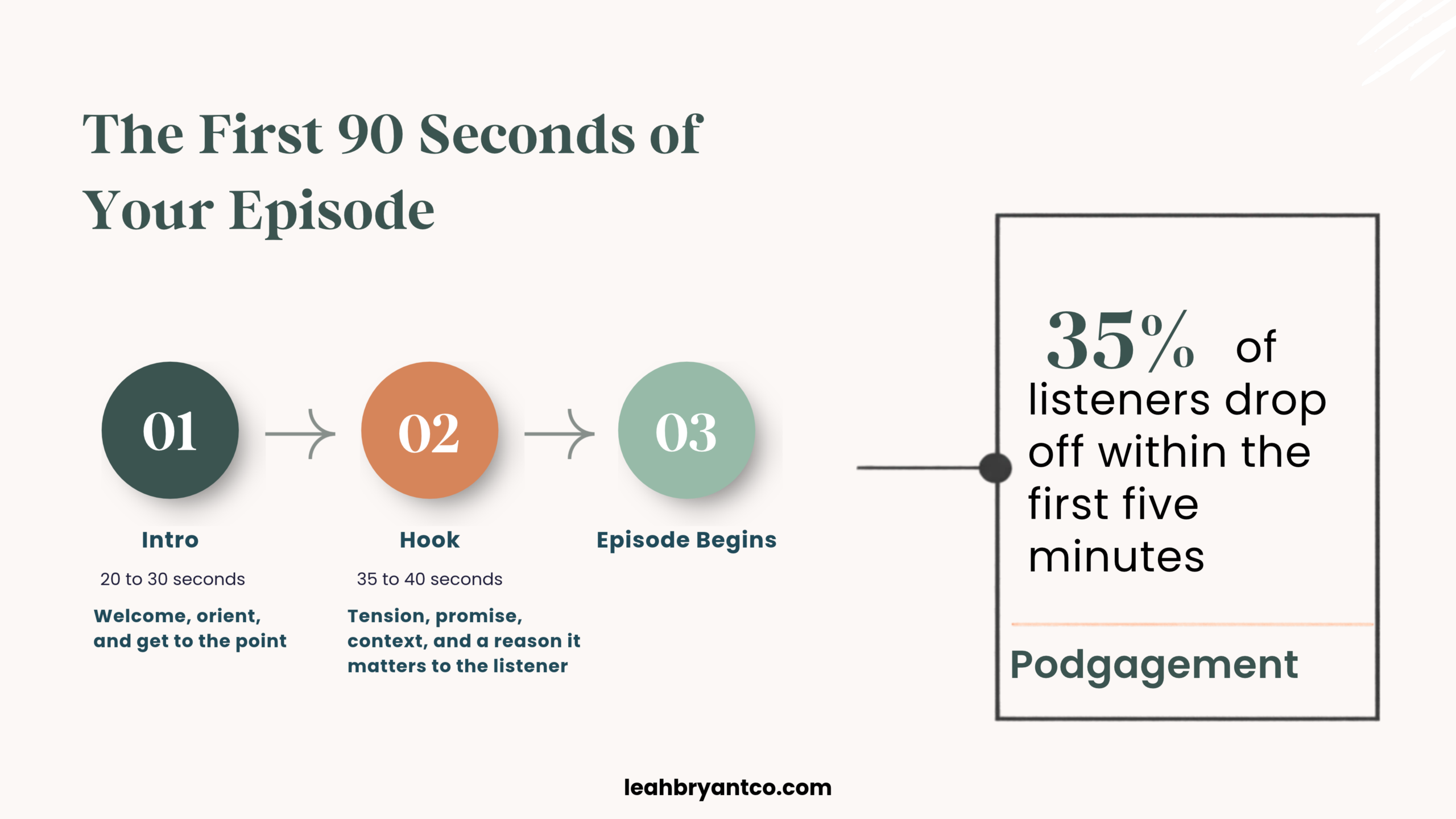
Your podcast hook has less time to earn attention than most hosts want to admit. Podgagement’s research on listener behavior found that 35% of listeners drop off within the first five minutes of an episode, and most decide even earlier. If your podcast hook is buried under a three-minute intro, a round of hellos, and a vague promise about what today’s episode covers…the listener who was on the fence about staying already left.
I audit podcast episodes every day, and the piece I look at the closest is what makes someone stay past the first few minutes or run away like Real McCoy. The hook is where I find the same handful of problems, over and over, on shows run by smart people who know their industry and still can’t get a stranger to make it to minute six.
Why do most podcast hooks fail before the point lands?
A hook fails for a couple of reasons, and sometimes it’s a mix of them. These are some common mistakes:
- There’s no tension in the opening—nothing that makes a listener need to know what happens next.
- No fact or story to pull the listener into the episode.
- The audio itself is bad, which may seem unrelated to hook-writing until you remember that a listener’s brain registers poor sound quality as a reason to leave before the topic ever clicks.
- The intro runs long (especially with two hosts). Small talk fills the first ninety seconds, long before anyone says anything a stranger would care about.
- A chunk of self-promotion or announcements up front tells a new listener this show is talking to its existing audience, not them.
Any one of these will cost you listeners. Most struggling shows have 3 or 4 of them stacked on top of each other.
You have about three minutes, and more of it gets decided early
Here’s how I structure the opening of an episode, and how I tell clients to structure theirs.
Intro: 20 to 30 seconds. One sentence, maybe two, and then straight into the hook. Hook: another 30 to 40 seconds. Then you’re into the actual episode.
That’s it. No three-minute intro, because nobody has time for it and nobody wants it. If you want an intro at all, keep it to one sentence and move on.
The listener didn’t press play to hear who you are. They pressed play because something in your title or description made them curious, and the first minute of the episode either confirms that curiosity was worth acting on or gives them permission to bail.
What goes into a podcast hook that works?
A working hook does four things.
- It creates tension, something unresolved that makes the listener want the next sentence.
- It makes a promise, a specific thing the listener will get by staying.
- It adds context, just enough for the promise to make sense.
- It moves the listener, gives them a reason this episode matters to their actual situation, not just an abstract “you’ll learn about X.”
You can build that tension three ways.
A specific payoff: naming the exact outcome or number the episode delivers.
A story: a real situation, positioned right at the moment where things went wrong or were about to.
Or a contrarian perspective: naming the thing everyone believes and telling the listener you’re about to argue against it.
Pick whichever fits that specific episode. The mechanism matters more than the format.
What I see over and over when I audit podcast hooks
Four mistakes show up on repeat, regardless of industry or show size.
- The host waits too long to get to the point, and the listener loses interest before the episode delivers on its promise.
- The hook is too vague, so the listener can’t tell in the first thirty seconds whether this episode is for them. When in doubt, specificity is the answer, not more scene-setting.
- The host tries to educate right out of the gate instead of earning attention first, when education belongs later in the episode, after the listener has already decided to stay.
- The hook leads with inside talk between co-hosts, self-promotion, or “welcome to episode number thirty-four” instead of getting straight to it.
Pull up your last episode and listen to the first ninety seconds. Odds are you’ll hear at least one of these.
What happened when a member in my membership cut her intro
Members in my membership use my Problem Solver Episode Outline, which gives every episode a repeatable shape so nobody has to reinvent the structure every time they sit down to plan. The outline comes out of the Podcasting Problem Solver Framework, the way I work with every client. Step one is the hook, and the outline puts it this way: “Open by naming something your ideal listener is already thinking about or frustrated by this week, and promise a specific shift by the end. The before-and-after has to be concrete enough for them to feel it.”
Once members started using it, their hooks started getting better, and then listeners started booking calls.
One member in particular is a coach who runs a show for women in midlife. Her episodes used to go hook, then intro, then the episode, and by the time the episode actually started, she was 1:57 in. Now she has nothing before it. She jumps right into the episode, which is fabulous.
A show with 80% consumption and the hooks behind it
Get Sculpted, a podcast on sustainable fat loss and building muscle, averages 80% consumption across all of its episodes on Apple Podcasts. I credit their hooks and their content for that retention.
Here is how one of their episodes opens: “This is 5 decisions the 2.0 version of you is doing differently.” By the second sentence, the listener knows the topic and the promise. A few lines later comes the proof, “over 1,000 women that we’ve worked with at this point collectively,” and then the line doing the most work: “If you’ve ever said something like, when I lose the weight, I will finally fill in the blank. Then this episode is for you.” The listener hears her own sentence read back to her and decides to stay.
This opening also breaks my timing rule. It runs 1:47, it starts with “Welcome back to another episode,” and it introduces three hosts before the topic. Their consumption stays at 80% anyway, which tells me the specific promise and the “this episode is for you” lines carry more weight than how long the hook is. Check your own analytics before you trim anything.
What the shift sounds like
This is a made-up example so you can hear the pattern. It isn’t from a real client’s podcast.
Before:
“Hey everyone, welcome back to the show. Before we get started, I want to remind you to leave a review if you haven’t already. It really helps us out. Okay, so today we’re going to be talking about email marketing, which is something a lot of people ask me about, and I think you’re going to find this really valuable.”
That’s about 30 to 40 seconds, and the listener still doesn’t know what they’ll walk away with. Nothing creates tension or makes a promise, so they have no reason to keep going.
After:
“You hit send on the email and heard nothing back. Today I’m walking through the first thing I’d check, so you know what to change before your next send.”
Same topic, the second version opens on a moment the listener already knows and tells them what they’ll leave with.
Solo and interview episodes, the hook doesn’t change
I get asked whether this structure shifts for interview episodes versus solo ones. It doesn’t.
Short intro, hook with a promise, straight into the episode, every time, regardless of who’s in the episode.
The temptation with guest episodes is to spend the opening on introductions and rapport-building with the guest. Save it. The listener doesn’t know your guest yet and doesn’t care about the rapport until they’ve decided the topic is worth their time.
Read to fix your podcast hooks?
A hook problem is usually the visible issue of a bigger one: no one gave your podcast a job, and it shows up first in the opening thirty seconds because that’s where a vague show has nowhere to hide.
Fixing the hook gets you a better opening. Fixing the overall podcast positioning is what makes every future hook easier to write, because you already know the promise you’re making and who you’re making it to.
If your hooks keep failing, it’s worth checking whether the actual problem sits earlier than the hook itself. The Problem Solver Request Line is 1:1 asynchronous coaching with unlimited access to me, so you can bring me the hook that keeps missing, and we’ll find what’s causing it.

Meet Leah
I help entrepreneurs build podcasts that grow their business with strategy, support, and less overwhelm.
I'm looking for...